


RAPID DISPATCH
24/H dispatch
2 in stock
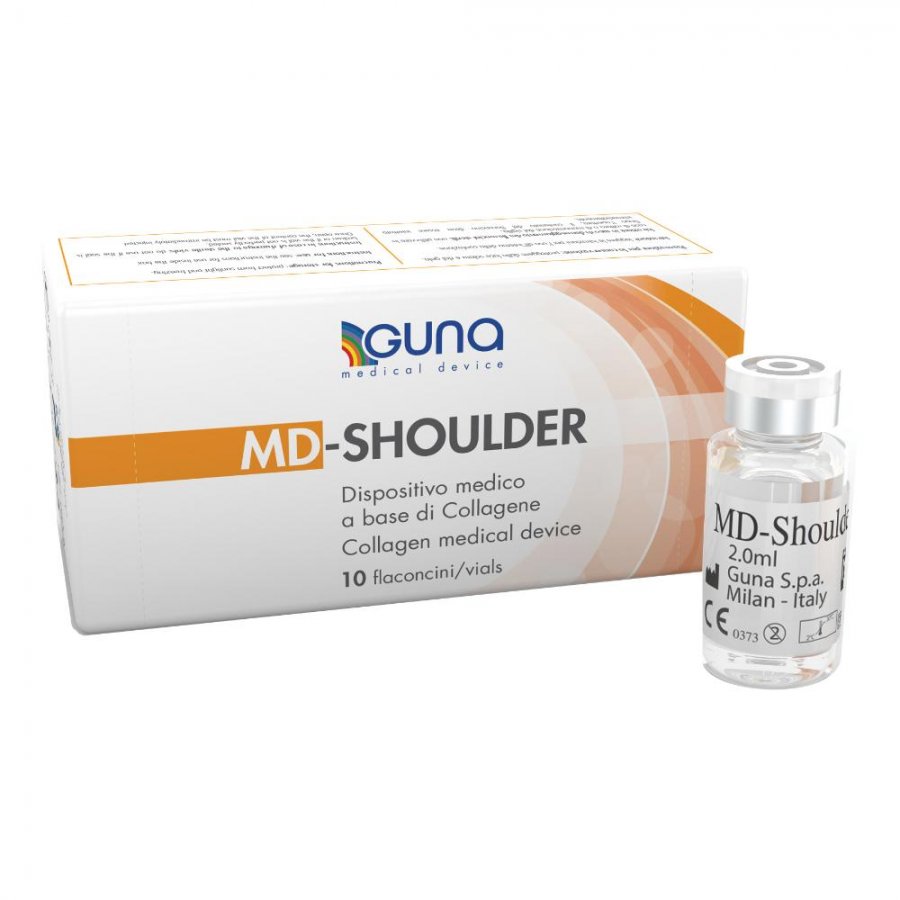
MD-SHOULDER is a medical device designed to improve movement of the shoulder and upper limb and to reduce associated pain by counteracting physiological or pathological deterioration of the shoulder joint, elbow and surrounding tissues (joint capsule and serous bursae).
USE MEDICAL STRICT. Medical device. Use reserved for dermatologists and aesthetic doctors because they require a medical procedure.
MD-SHOULDER is an injectable class III medical device:
- Barrier effect, lubricating activity and mechanical support during other drug therapies.
- It promotes muscle relaxation, supports muscle structures and relieves localised or movement-induced pain.
- It can be combined with other treatments.
- GUNA S.P.A.
- NAME: MD-SHOULDER
- COMPOSITION: Collagen, Iris, Sodium chloride, Water for injection preparations.
- PRESENTATION: 10 x 2ml.
- INDICATIONS: Effectively reduces pain and improves joint mobility of the shoulder and upper limb.
- INJECTION DEPTH: Peri-articular administration: insert the needle close to the joint to a minimum depth of 13-25 mm. Intra-articular administration: insert the needle below the lower edge of the posterior angle of the acromion, directing it towards the coracoid process.
- PROTOCOL: 1-2 infiltrations per week to limit the physiological deterioration of joints and tissues (tendons and ligaments). Results are evident from the third to the fifth week.
- USE: Strict medical use.
- Vials: 10 x 2ml.
Shoulder and upper limb.
Collagen, Iris, Sodium chloride, Water for injectable preparations.
- Before proceeding with treatment, make a differential diagnosis of the shoulder: e.g. pain that may result from chronic cervical syndrome, ischaemic heart disease (especially for the left shoulder), cholecystitis/cholelithiasis (especially for the right shoulder).
- The product must be administered by qualified healthcare personnel using correct technique (skin disinfection, choice of needle/injection position) to avoid local complications.
- Although well-tolerated, local redness or a burning/pain sensation in the injection area may occur, which generally resolves within 5-10 minutes.
- Use with caution if rehabilitation sessions are planned immediately after injection: in some cases, immediate mobilisation of the treated area may reduce the effectiveness of the device.
- In general, there are not many contraindications explicitly indicated for MD-SHOULDER, other than known hypersensitivity to the components of the product.
- Use is not recommended in the presence of septic processes in the joint (i.e. active joint infections) or other conditions that would contraindicate an intra-articular injection.
Scientific evidence demonstrates the efficacy and safety of MD-SHOULDER in the following cases:
- Glenohumeral arthrosis.
- Acromioclavicular arthrosis.
- Sternoclavicular arthrosis.
- Calcific tendonitis of the supra-spine.
- Acute scapulohumeral periarthritis and sub-deltoid bursitis.
- Injuries with partial thickening of the rotator cuff.
- Painful shoulder in patients with post-stroke haemiplegia.
- Subacromial conflict (shoulder impingement syndrome).
- Rotator cuff syndrome.
- Scapulohumeral dislocation.
- Epicondylitis resistant to other treatments.
- Contractures.
- Arthritic conditions:
- due to ageing
- due to incorrect posture
- due to concomitant chronic diseases
- due to trauma and injuries
MD-SHOULDER is a collagen-based injectable medical device designed to reduce pain and improve mobility in the shoulder and upper limb, supporting the treatment of joint, tendon and inflammatory disorders of the shoulder.
MD-SHOULDER can be administered periarticularly (13-25 mm depth) or intra-articularly, with the needle directed towards the coracoid process below the acromion margin. The protocol generally involves 1-2 infiltrations per week.
Results are generally visible from the third to fifth week of treatment, depending on the patient's clinical condition and individual response to therapy.
Only qualified medical personnel, as this is an injectable medical device that requires sterile technique, correct diagnosis and clinical evaluation of the patient before use.
It is contraindicated primarily in cases of hypersensitivity to the components of the product or in the presence of active joint infections that could interfere with an intra-articular injection.

 Italian Italian
  English