


RAPID DISPATCH
24/H dispatch
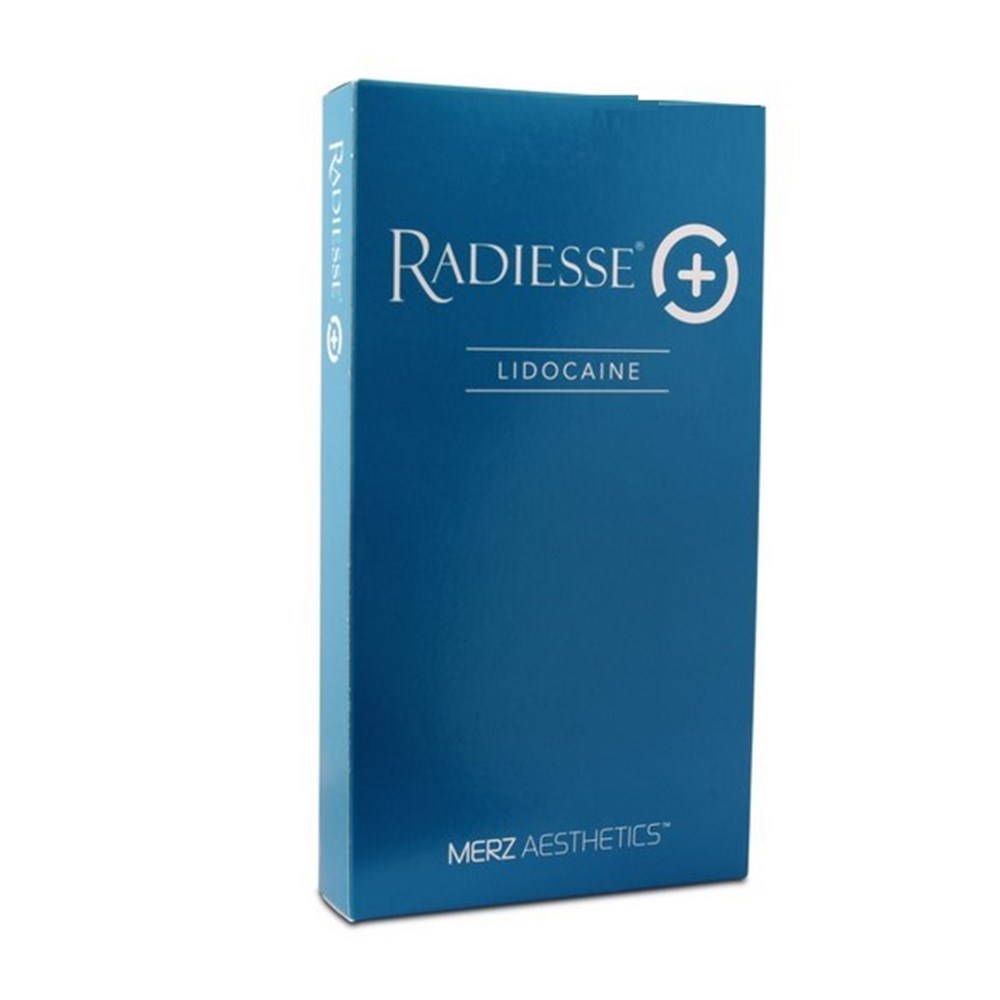
€147,08
6 in stock
RADIESSE® + Lidocaine Injectable Implant is a sterile, latex-free, apyrogenic, semi-solid, cohesive implant. The main component of the product is synthetic calcium hydroxyapatite (CaHA), suspended in a carrier gel consisting essentially of water (sterile USP for injectable preparations), glycerine (USP/EuP), sodium carboxymethylcellulose (USP/EuP) and lidocaine hydrochloride 0.3%. The gel dissolves in vivo and is replaced as the soft tissue grows, while the calcium hydroxyapatite remains at the injection site. Lidocaine provides a short-lasting local anaesthetic effect. The result is long-term but not permanent restoration and augmentation. RADIESSE® + Lidocaine Injectable Implant (1.5 mL) has a calcium hydroxyapatite particle size of 25-45 microns and must be injected with a 27G needle fitted with a standard Luer fitting. RADIESSE® + Lidocaine Injectable Implant is steam sterilised using a parametric release cycle. The steam sterilisation process is considered validated up to a Sterility Assurance Level (SAL) of at least 10-6.
USE MEDICAL STRICT. Medical device. Injection of hyaluronic acid. Use reserved for dermatologists and aesthetic doctors because they require a medical procedure.
RADIESSE® + Lidocaine Injectable Implant is a sterile implant:
- Latex-free, apyrogenic, semi-solid and cohesive.
- A whitish, viscoelastic implant consisting of a homogeneous suspension of calcium hydroxyapatite (CaHA) microspheres in an aqueous carboxymethylcellulose gel.
- Composed of 56% CaHA particles 25-45 µm (w/w). 44% gel (w/w). 36.0% sterile water for injections. 6.6% glycerine. 1.4% sodium carboxymethyl cellulose (NaCMC)
- Treatment of nasolabial folds, cheek augmentation procedure, hand volume restoration procedure to correct volume loss in the back of the hands, treatment of marionette wrinkles, jaw treatment.
- Biphasic technology based on calcium hydroxyapatite (CaHA) microspheres.
- Its formulation is based on synthetic calcium hydroxyapatite (CaHA) microspheres suspended in an aqueous carrier gel, to which a percentage of lidocaine is added for injection comfort.
- MERZ PHARMA ITALIA S.P.A.
- NAME: RADIESSE® + LIDOCAINE INJECTABLE IMPLANT
- COMPOSITION: 30% CaHA particles 25-45 µm (v/v), 70% gel (v/v). Glycerine 6.3% 6.5%, Water for Injectable Preparation 35.4% 36.2%, Lidocaine HCl monohydrate 0.22% 0.23%, Phosphates 0.30% 0.31%, NaCMC 1.06% 1.36%, CaHA 55.6% 56.5%.
- PRESENTATION: 1 x 1.5ml.
- NEEDLES: 2 x 27G Terumo K-Pack II thin-walled injection needles.
- INDICATIONS: RADIESSE® + Lidocaine Injectable Implant is indicated for deep dermal and subdermal soft tissue augmentation.
- INJECTION DEPTH: Percutaneous.
- LENGTH: Treatment of nasolabial folds: at least 6-7 months - Cheek augmentation: at least 12 months - Treatment of marionette wrinkles: at least 6-7 months - Treatment of the jaw: at least 12 months - Restoration of hand volume to correct loss of volume in the back of the hands: at least 12 months.
- USE: Strict medical use.
- Syringe: 1 x 1.5 ml.
- Needles: 2 x 27G thin-walled injection needles.
- One syringe contains 1.5 mL of RADIESSE® + Lidocaine Injectable Implant.
- The gel is sold in a pre-filled, steam-sterilised disposable syringe.
- Each box contains one 1.5mL syringe of RADIESSE® + Lidocaine Implant Injectable, 2 sterile single-use 27G thin-walled injection needles reserved exclusively for RADIESSE® + Lidocaine Implant Injectable, instructions for use and labels to ensure traceability.
Face and hands.
- 30% CaHA particles 25-45 µm (v/v).
- 70% gel (v/v).
- Glycerine 6.3% 6.5%.
- Water for injectable preparations 35.4% 36.2%.
- Lidocaine HCl monohydrate 0.22% 0.23%.
- Phosphates 0.30% 0.31%.
- NaCMC 1.06% 1.36%.
- CaHA 55.6% 56.5%.
- In order to minimise the risk of potential complications, RADIESSE® + Lidocaine Injectable Implant should only be used by healthcare professionals with appropriate training and experience and who are familiar with the anatomy of the injection site and surrounding areas.
- In order to minimise the risk of potential complications, healthcare professionals should study the product, the instructional material and the entire package leaflet.
- The safety and efficacy of a deep injection cannula (subdermal and/or supraperiosteal) for soft tissue expansion and improvement of the jaw contour were clinically evaluated with a 27G and 40 mm blunt tip cannula and a 25G pre-pierced needle. US clinical study with RADIESSE® + Lidocaine Injectable Implant.
- Healthcare professionals are encouraged to discuss the potential risks of soft tissue injection with their patients prior to treatment and to ensure that patients are aware of the signs and symptoms of potential complications.
- As with all transcutaneous procedures, the injection of RADIESSE® + Lidocaine Injectable Implant carries a risk of infection. Infection may require surgical removal of the RADIESSE® + Lidocaine Injectable Implant. Use standard precautions for injectable materials.
- Patients using drugs that prolong bleeding, such as aspirin or warfarin, may experience increased bruising or bleeding at the injection site, as would occur with any injection.
- The calcium hydroxyapatite (CaHA) particles in RADIESSE® + Lidocaine Injectable Implant are radio-opaque and clearly visible in CT scans, MRI scans, mammograms or even plain radiographs. Individuals should be informed of the radio-opaque nature of RADIESSE® + Lidocaine Injectable Implant so that this can be reported to the general practitioner and radiologist. An X-ray study of 58 people found no cases where RADIESSE® Implant Injectable (without lidocaine) masked the presence of abnormal tissue or was detected as a tumour mass on CT scans.
- To facilitate percutaneous injection, apply RADIESSE® + Lidocaine Injectable Implant into soft tissue. Scarred or severely compromised tissue may not tolerate the treatment.
- Infections may occur at the injection site and must be treated appropriately. If such infections cannot be eradicated, the implant may have to be removed.
- Injection-associated reactions such as erythema, swelling, pain, itching, discolouration or sensitivity may occur at the injection site. These phenomena generally disappear spontaneously one or two days after injection.
- Nodules may form that require medical treatment or removal.
- Any irregularities in the contour may require corrective surgery.
- Do not inject an overdose into the area to be treated. In extreme cases, rupture of the injection site may occur. RADIESSE® + Lidocaine Injectable Implant can be added easily in subsequent injections, but cannot be removed as easily.
- The RADIESSE® + Lidocaine implant injection procedure, like other similar procedures, poses minor risks of infection and/or bleeding. To prevent possible infection, observe the normal precautions for percutaneous injection procedures.
- Do not re-sterilise. RADIESSE® + Lidocaine Injectable Implant is supplied sterile and non-pyrogenic in a sealed film pouch and is intended for single patient use and treatment.
- Carefully examine the aluminium pouch to check that neither the pouch nor the syringe has been damaged during shipment. Do not use the product if there is a compromised pouch or damaged syringe. Do not use the syringe if the protective cap or plunger is not in place. Normally, a small amount of moisture from sterilisation forms inside the aluminium pouch: this does not indicate a defective product.
- RADIESSE® + Lidocaine Injectable Implant is contraindicated in the presence of acute and/or chronic inflammation or infection involving the area to be treated.
- RADIESSE® + Lidocaine Injectable Implant is contraindicated in patients with severe allergies
manifested by a history of anaphylaxis, as well as in the case of a history or presence of several
severe allergies.
- Do not use RADIESSE® + Lidocaine Injectable Implant in patients with known hypersensitivity to any of the components of the product.
- RADIESSE® + Lidocaine Injectable Implant should not be used in persons with known hypersensitivity to lidocaine or amide anaesthetics.
- RADIESSE® + Lidocaine Injectable Implant is contraindicated in individuals prone to developing inflammatory skin conditions or with a tendency to develop hypertrophic and keloid scars.
- Do not implant the product into the epidermis or use it as a skin substitute. Implantation in the epidermis or superficial dermis may cause complications such as fistula formation, infection, extrusion, nodules and induration.
- RADIESSE® + Lidocaine Injectable Implant is not indicated for the correction of glabellar and nasal area wrinkles. Injections into the glabellar and nasal area are associated with an increased incidence of localised necrosis. A forced injection into the vessels of the superficial dermis of the glabellar or nasal area may cause retrograde movement of the retinal arteries and lead to vessel occlusion.
- RADIESSE® + Lidocaine Injectable Implant is contraindicated in the presence of foreign bodies such as liquid silicone or other particulate materials.
- Do not use RADIESSE® + Lidocaine Injectable Implant in areas where there is inadequate coverage of healthy, well-vascularised tissue.
- Do not use RADIESSE® + Lidocaine Injectable Implant on patients with systemic disorders that slow or complicate wound healing or are capable of causing tissue deterioration over the implant.
- RADIESSE® + Lidocaine Injectable Implant is contraindicated in individuals with bleeding disorders.
- RADIESSE® + Lidocaine Injectable Implant is contraindicated in persons under 18 years of age.
RADIESSE® + Lidocaine Injectable Implant is indicated for:
- The treatment of nasolabial folds.
- Cheek augmentation.
- The treatment of marionette wrinkles.
- The treatment of the jaw.
- The restoration of hand volume to correct volume loss in the back of the hands.
The contents of the RADIESSE® + Lidocaine Injectable Implant syringe are steam sterilised. The 27G needles are sterilised with ethylene oxide.
RADIESSE® + Lidocaine is an injectable filler with calcium hydroxyapatite microspheres suspended in gel. The gel dissolves by replacing itself with soft tissue, while the microspheres retain their volume in the long term.
It is indicated for nasolabial folds, cheek augmentation, marionette wrinkles, jaw treatment and restoration of hand volume, and is reserved for experienced physicians.
It contains 25-45 micron calcium hydroxyapatite microspheres in an aqueous gel with sterile water, glycerine, carboxymethylcellulose and lidocaine.
It is injected percutaneously with 27G needles supplied in the package, performed by qualified medical personnel in deep or subdermal soft tissue.
The effect lasts about six to seven months for nasolabial folds and marionette wrinkles, and about twelve months for cheeks, jaw and hands; it is not permanent but can be supplemented with subsequent injections.

 Italian Italian
  English